by Terry Heick
High quality– you know what it is, yet you do not know what it is. But that’s self-contradictory. Yet some points are much better than others, that is, they have a lot more top quality. However when you attempt to claim what the high quality is, besides the things that have it, it all goes poof! There’s absolutely nothing to talk about. However if you can’t claim what High quality is, how do you know what it is, or just how do you understand that it also exists? If nobody knows what it is, then for all practical purposes it does not exist at all. But for all sensible purposes, it actually does exist.
In Zen and the Art of Bike Maintenance , author Robert Pirsig talks about the evasive concept of top quality. This idea– and the tangent “Church of Factor”– heckles him throughout the book, especially as a teacher when he’s trying to discuss to his pupils what high quality creating looks like.
After some struggling– inside and with students– he tosses out letter grades completely in hopes that students will quit trying to find the incentive, and begin seeking ‘high quality.’ This, certainly, doesn’t end up the means he wished it would certainly might; the pupils revolt, which only takes him additionally from his objective.
So what does quality involve understanding? Quite a bit, it ends up.
A Shared Feeling Of What’s Possible
Quality is an abstraction– it has something to do with the stress between a point and an ideal thing. A carrot and an optimal carrot. A speech and an optimal speech. The way you desire the lesson to go, and the means it in fact goes. We have a lot of basic synonyms for this concept, ‘excellent’ being among the much more usual.
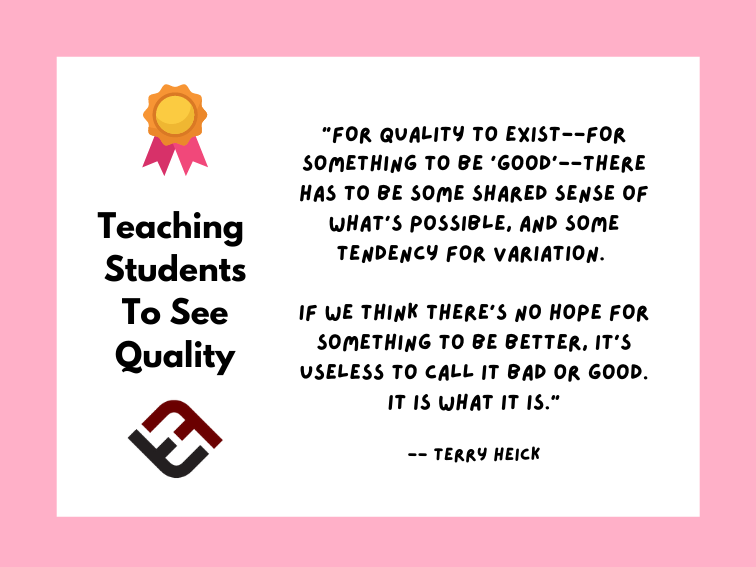
For high quality to exist– for something to be ‘good’– there has to be some common feeling of what’s feasible, and some tendency for variation– incongruity. For instance, if we believe there’s no expect something to be much better, it’s useless to call it poor or good. It is what it is. We rarely call strolling great or negative. We simply stroll. Singing, on the other hand, can definitely be great or negative– that is have or do not have high quality. We know this because we’ve heard excellent vocal singing prior to, and we know what’s feasible.
Better, it’s challenging for there to be a top quality sunrise or a high quality decline of water since many sunrises and many drops of water are really similar. On the other hand, a ‘quality’ cheeseburger or performance of Beethoven’s 5 th Harmony makes more feeling because we A) have had a good cheeseburger before and recognize what’s feasible, and B) can experience a large distinction between one cheeseburger and an additional.
Back to discovering– if trainees can see high quality– determine it, examine it, recognize its qualities, and so on– envision what that requires. They need to see right around a thing, contrast it to what’s feasible, and make an assessment. Much of the rubbing between instructors and students comes from a type of scuffing in between students and the teachers attempting to assist them in the direction of top quality.
The educators, of course, are only trying to aid students understand what quality is. We describe it, produce rubrics for it, direct it out, design it, and sing its commends, however usually, they do not see it and we press it better and closer to their noses and wait for the light ahead on.
And when it does not, we think they either do not care, or aren’t trying hard enough.
The very best
And so it selects loved one superlatives– excellent, much better, and ideal. Students make use of these words without knowing their starting factor– top quality. It’s tough to understand what top quality is till they can think their method around a thing to begin with. And then better, to really internalize points, they have to see their top quality. High quality for them based upon what they view as possible.
To qualify something as good– or ‘best’– requires initially that we can concur what that ‘point’ is supposed to do, and afterwards can talk about that thing in its native context. Take into consideration something basic, like a lawnmower. It’s simple to figure out the high quality of a lawnmower because it’s clear what it’s expected to do. It’s a tool that has some levels of performance, however it’s primarily like an on/off button. It either functions or it doesn’t.
Various other things, like federal government, art, technology, etc, are much more complex. It’s unclear what quality looks like in legislation, abstract painting, or economic leadership. There is both subtlety and subjectivity in these things that make examining quality even more intricate. In these cases, pupils need to think ‘macro sufficient’ to see the ideal features of a thing, and then choose if they’re working, which obviously is impossible because no person can concur with which features are ‘ideal’ and we’re right back at zero once more. Like a circle.
Quality In Student Thinking
And so it goes with training and knowing. There isn’t a clear and socially agreed-upon cause-effect partnership between mentor and the world. Quality mentor will generate high quality learning that does this. It’s the same with the pupils themselves– in writing, in analysis, and in thought, what does high quality appear like?
What causes it?
What are its characteristics?
And most notably, what can we do to not only aid students see it yet develop eyes for it that decline to close.
To be able to see the circles in everything, from their own feeling of ethics to the method they structure paragraphs, style a task, research study for tests, or fix troubles in their own lives– and do so without using adultisms and exterior labels like ‘good work,’ and ‘excellent,’ and ‘A+’ and ‘you’re so wise!’
What can we do to support students that are going to sit and stay with the stress between possibility and truth, bending everything to their will moment by minute with love and understanding?