The plan also featured an unpleasant side effect. The cellular phone prohibits led to a considerable increase in trainee suspensions in the initial year, specifically among Black pupils. But disciplinary activities decreased throughout the 2nd year.
“Cellular phone bans are not a silver bullet,” said David Figlio, a financial expert at the University of Rochester and one of the research study’s co-authors. “However they seem to be aiding youngsters. They’re participating in school more, and they’re doing a bit better on examinations.”
Figlio claimed he was “anxious” regarding the short-term 16 percent rise in suspensions for Black trainees. What’s uncertain from this data analysis is whether Black students were more likely to go against the brand-new cellular phone rules, or whether teachers were more likely to select Black trainees for punishment. It’s also vague from these administrative habits records if trainees were initial offered warnings or lighter punishments prior to they were suspended.
The data suggest that students adapted to the new guidelines. A year later on, pupil suspensions, including those of Black trainees, dropped back to what they had been before the mobile phone ban.
“What we observe is a rocky beginning,” Figlio added. “There was a great deal of technique.”
The research, “The Effect of Cellular Phone Bans in Schools on Student Outcomes: Proof from Florida,” is a draft working paper and has not been peer-reviewed. It was slated to be distributed by the National Bureau of Economic Research Study on Oct. 20 and the authors shared a draft with me ahead of time. Figlio and his co-author Umut Özek at RAND think it is the initial research to show a causal connection in between cellular phone restrictions and finding out instead of simply a correlation.
The academic gains from the cellular phone ban were little, less than a percentile factor, typically. That’s the matching of moving from the 50 th percentile on math and analysis examinations (in the center) to the 51 st percentile (still close to the middle), and this tiny gain did not arise until the 2nd year for a lot of pupils. The scholastic benefits were greatest for center schoolers, white trainees, Hispanic trainees and male students. The scholastic gains for Black students and female trainees were not statistically considerable.
I was surprised to learn that there is information on student cellular phone use in institution. The authors of this study used info from Advan Research Corp., which gathers and assesses data from mobile phones around the world for company objectives, such as figuring out the number of people see a specific store. The scientists had the ability to get this data for schools in one Florida college district and estimate how many pupils got on their cellphones prior to and after the restriction entered into impact between the hours of 9 a.m. and 1 p.m.
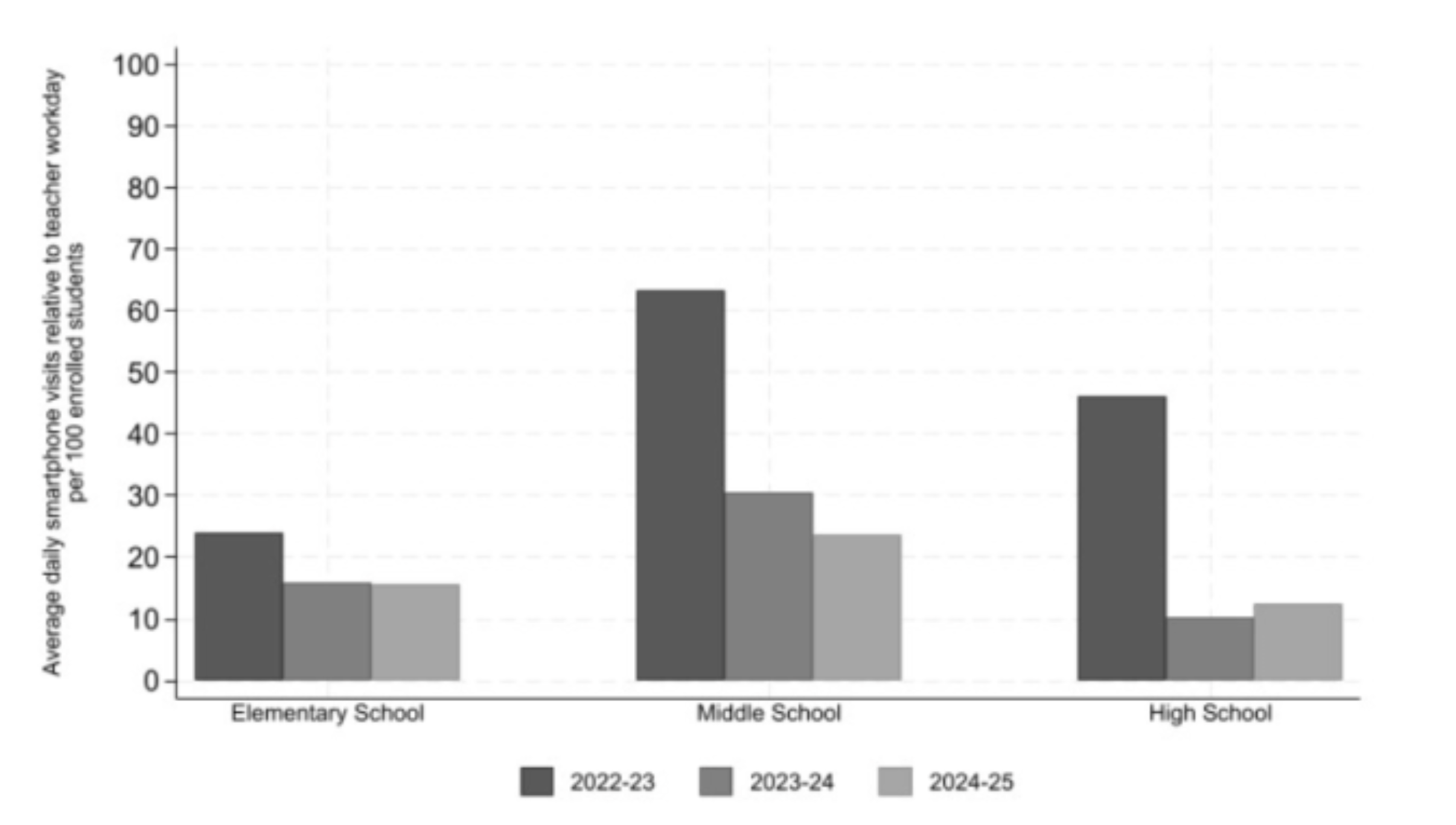
The information revealed that greater than 60 percent of center schoolers, on average, got on their phones a minimum of once during the college day before the 2023 ban in this specific Florida district, which was not called however described as among the 10 biggest districts in the nation. (5 of the country’s 10 biggest school districts remain in Florida.) After the ban, that fell in fifty percent to 30 percent of center schoolers in the first year and down to 25 percent in the 2nd year.
Grade school trainees were less likely to be on mobile phones to start with and their in-school use dropped from regarding 25 percent of trainees before the restriction to 15 percent after the restriction. More than 45 percent of high schoolers got on their phones before the ban and that was up to concerning 10 percent afterwards.
Typical day-to-day smartphone gos to in schools, by year and grade degree
Florida did not enact a total cellphone ban in 2023, yet enforced extreme restrictions. Those limitations were tightened up in 2025 which extra tightening was not researched in this paper.
Anti-cellphone plans have come to be progressively prominent considering that the pandemic, mostly based on our cumulative grown-up gut suspicions that youngsters are not finding out well when they are eaten by TikTok and SnapChat.
This is probably an unusual case in public law, Figlio said, where the “data back up the hunches.”
Call staff author Jill Barshay at 212 – 678 – 3595, jillbarshay. 35 on Signal, or [email protected]
This tale about mobile phone outlaws was generated by The Hechinger Report , a not-for-profit, independent news organization focused on inequality and technology in education and learning. Sign up for Evidence Things and various other Hechinger newsletters