Teach Trainees To Think Irrationally
by Terry Heick
Formal discovering is a humbling point.
As planners, designers, administrators, and basic caretakers of public and private education and learning systems, we are tasked with the overwhelming: get rid of a kid’s natural propensity to play, rebel, and self-direct in hopes of giving them with a ‘great education and learning.’ Reading, creating, arithmetic, and so on.
And this isn’t incorrect. This is great by virtually any measure. Our intent is noble, our initiative amazing, and certainly the learning of several youngsters, specifically those from disadvantaged circumstances, is much better than anything they could have had otherwise.
Yet there’s additionally a regrettable, darker side to formal learning procedures– especially when you crowd 800 in an institution and 32 in a classroom and ‘hold instructors accountable.’
This is a side that can be much more concerned with that accountability than anything else– and that means pupils answerable to teachers, teachers responsible to principals, principals liable to superintendents, superintendents liable to state government firms, and everyone accountable to many steps of ‘motivation’ and/or vindictive action.
See additionally Trainee Interaction Methods
The internet result can be a knowing environment where spontaneity, curiosity, and student self-direction are second to simply the best ‘research-based’ literacy strategy to ‘move kids to proficiency’– and a vital loss of ‘childlishness’ of learning.
It’s within this context that I enjoyed the complying with video by Adora Svitak, who eloquently (please inform me this child was trained, otherwise I am mosting likely to wish she was additionally a lot more ‘juvenile’ herself) discusses the duty of ‘immaturity’ in fantastic achievements. Pertaining to ‘childlike’ actions and ‘immaturity,’ she clarifies:
“Then again, who’s to say that particular types of illogical thinking aren’t precisely what the world requires? Perhaps you have actually had grand strategies before yet stopped on your own, thinking, “That’s difficult,” or, “That costs excessive,” or, ‘That won’t benefit me.’
“For far better or worse, we children aren’t hampered as a lot when it involves thinking about reasons that not to do points. Kids can be loaded with inspiring aspirations and confident reasoning. Like my wish that no one went starving or that whatever were a cost-free kind of paradise. The number of of you still fantasize like that and believe in the opportunities? In some cases an understanding of history and the past failures of optimistic perfects can be a concern since you understand that if everything were free, after that the food stocks would come to be diminished and scarce and cause turmoil. On the other hand, we children still fantasize regarding perfection.
“Which’s a good thing because in order to make anything a truth, you have to fantasize concerning it initially.”
It’s simple to take that argument a step even more and wonder what education would certainly be like if it had the ability to actually lose itself in the discovering, and be fully engaged in web content and area. Standards? Fine. Evaluation? Penalty– but standardize the analysis without systematizing the learning.
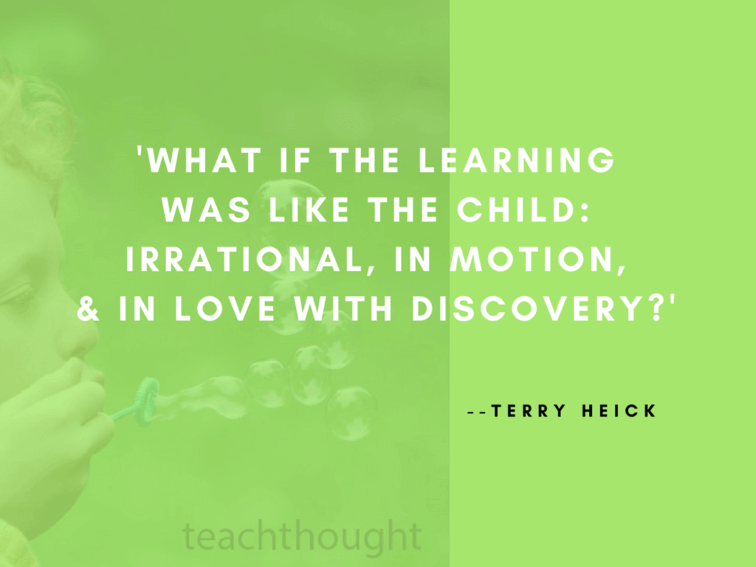
Suppose the discovering resembled the youngster: unreasonable, moving, and in love with exploration?
You can see the video clip right here.